CONTACT US     
DIRECTIONS     
myHALO     
HOME
ABOUT US
ADMISSIONS
FINANCIAL AID
POLICIES

HOME | FAITH FORMATION | Religion Curriculum | Grade 8
  

Grade 8 Objectives


Awareness of God  

Message: Doctrinal


·         Explains the Apostles’/Nicene Creed.

·         Acknowledges the power of the Holy Spirit to strengthen and guide him/her.

·         Identifies and explains the gifts/fruits of the Holy Spirit.

·         Identifies the marks of the church as being one, holy, Catholic, and apostolic.

·         Explains the Immaculate Conception, the annunciation, and the assumption.

·         Understands the teachings of heaven, hell, and purgatory.

·         Reviews the Ten Commandments, beatitudes, sacraments, and the spiritual and corporal works of mercy.

·         Understands the precepts of the church.

·         Describes God’s presence in the world today.

·         Is aware of the importance of his/her role in the future of the church.


Message: Historical


·         Recognizes Pentecost as the birth of the church.

·         Acknowledges Peter, the papacy, and apostolic succession.

·         Understands how first Christian communities grew – St. Paul and his missions.

·         Recognizes many early leaders, e.g. Ignatius of Antioch, Constantine, Justinian & Theodora, Theodosius. Reads and interprets Scripture passages telling about the early church.

·         Fosters knowledge of appreciation for other faiths, Judaism and Islam.

·         Learns about the challenges faced by the early church.

·         Recognizes how the church clarified its beliefs in Jesus.

·         Studies some of the causes and outcomes of the early councils (Jerusalem, Nicea).

·         Understands causes leading up to the church splitting into eastern & western Christianity.

·         Explores the creativity of the church during the Middle Ages.

·         Realizes the effect of Monasticism, e.g. monastic daily life, prayers, missionaries.

·         Recognizes the influences of the church during the Renaissance.

·         Understands how Martin Luther led the Protestant reformation.

·         Recognizes the church’s constant need for reform and renewal.

·         Recognizes different Christian denominations in the U.S.

·         Is made aware that the missionaries brought Christianity to Asia and Africa.

·         Learns how the Catholic faith was brought to the Americas.

·         Explores the growth of Catholicism in the U.S.

·         Recognizes that societal changes affected the church in the 19th century.

·         Recognizes important figures in American Catholic Church history, e.g. John Carroll, St. Elizabeth Ann Seton, Mother Cabrini, St. John Neumann, St. Katharine Drexell.


Awareness of values    

Morality: Personal


·         Recognizes that the foundation of Catholic morality is based upon Christ’s humanity.

·         Recognizes the need to develop skills for building and handling peer pressure.

·         Shows how listening, self-disclosure, and compromise are necessary communication skills.

·         Realizes the need to examine his/her own conscience.

·         Recognizes the way to the reign of God through justice and peace.

·         Relies on their Christian values to help them make social, economic, and political choices.

·         Recognizes and uses their gift of sexuality in ways that are pleasing to God.


Morality: Social


·         Explains the basic human rights of all people.

·         Values life as sacred from the first moment of conception.

·         Responds to the challenge of world hunger, poverty, war/peace, inequality, discrimination and anti-life issues.

·         Is aware that we live in a society that does not always agree with the teachings of our faith.

·         Acknowledges that some sins are collective: the wrongful acts of a group.


Morality: Service/Witness


·         Demonstrates Jesus’ commandment to love God with all our hearts and our neighbors as ourselves.

·         Realizes that service is an integral part to living the Catholic faith.

·         Explains how the church serves the world.

·         Participates in several service-oriented activities in church, family, school, community.

·         Identifies global needs of God’s family.

·         Recognizes stewardship as it relates to the distribution and use of resources.


Awareness of Others

Community: Developmental


·         Studies the concerns of a church community, such as helping those in need of shelter, food, clothing etc.

·         Identifies parish organizations as a way of reaching out, to the grieving, shut-ins, sick, formation.

·         Is encouraged to take part in the different ministries of the church, community building, community service, Liturgy of the Word, and Liturgy of the Eucharist.

·         Values the dignity of human life in the midst of a society with different views on, social abuses, medical practices, and scientific practices.

·         Learns the importance of the sanctity of the sacrament of marriage.

·         Defines personal attitudes of treating all people equally.

·         Learns the Catholic teachings in reference to contraception and Natural Family Planning.
 

Awareness of Spiritual Development

Worship: Scriptural


·         Identifies the parts of the New Testament.

·         Considers the epistles as letters written under the inspiration of the Holy Spirit.

·         Interprets the Acts of the Apostles as the beginning of the church and how it spread.

·         Reads, understands, interprets, and applies Scripture to their everyday lives.


Worship: Prayer


·         Defines prayer as a means of conversation with God.

·         Creates and participates in various forms of prayer: guided prayer, silent prayer, prayer journaling, spontaneous prayer.

·         Researches, writes, and presents the introduction and petitions for school liturgies.

·         Recognizes that singing is praying twice at the celebration of liturgy.

·         Plans prayer services, special devotions, and retreats around specific church themes.

·         Creates and leads prayer in the classroom as well as throughout the school.

·         Assumes a lead role when praying the rosary, Stations of the Cross, and other devotions.

·         Creates and prays different Litanies honoring special saints.

·         Expresses prayer not only through words but also art and music.

·         Recites from memory formal prayer:

o    Morning offering

o    Hail Holy Queen

o    Prayers after meals

o    Act of Contrition

o    Acts of faith, hope, and love

o    The Angelus

o    Come Holy Spirit

o    Prayer to St. Francis

o    Divine liturgy

o    Our Father and Hail Mary in Spanish

o    Mysteries of the rosary  


Worship: Sacraments


·         Learns that sacraments are special signs of Christ’s presence.

·         Identifies the sacraments of initiation, healing and commitment.

·         Understands that through the sacraments the church welcomes, heals, and calls us to

·         serve others.

·         Appreciates that sacramentals remind us of the presence of Jesus.

·         Realizes that through receiving the sacraments he/she becomes spiritually stronger through grace.

·         Acknowledges the importance of an examination of conscience.

·         Understands the need for frequent reception of the sacraments of reconciliation and

·         Eucharist.

·         Is taught that we celebrate the real presence of Christ in the Eucharist – transubstantiation.

·         Becomes more aware of taking ownership of their faith through the sacraments.


Worship: Liturgical


·         Affirms that worship belongs to God alone.

·         Recognizes the Eucharistic liturgy as the community act of worship.

·         Reviews the Liturgical seasons and colors associated with each season.

·         Develops a greater understanding of what takes place during the celebration on Mass.

·         Is capable of actively taking part in all responses of the Mass.

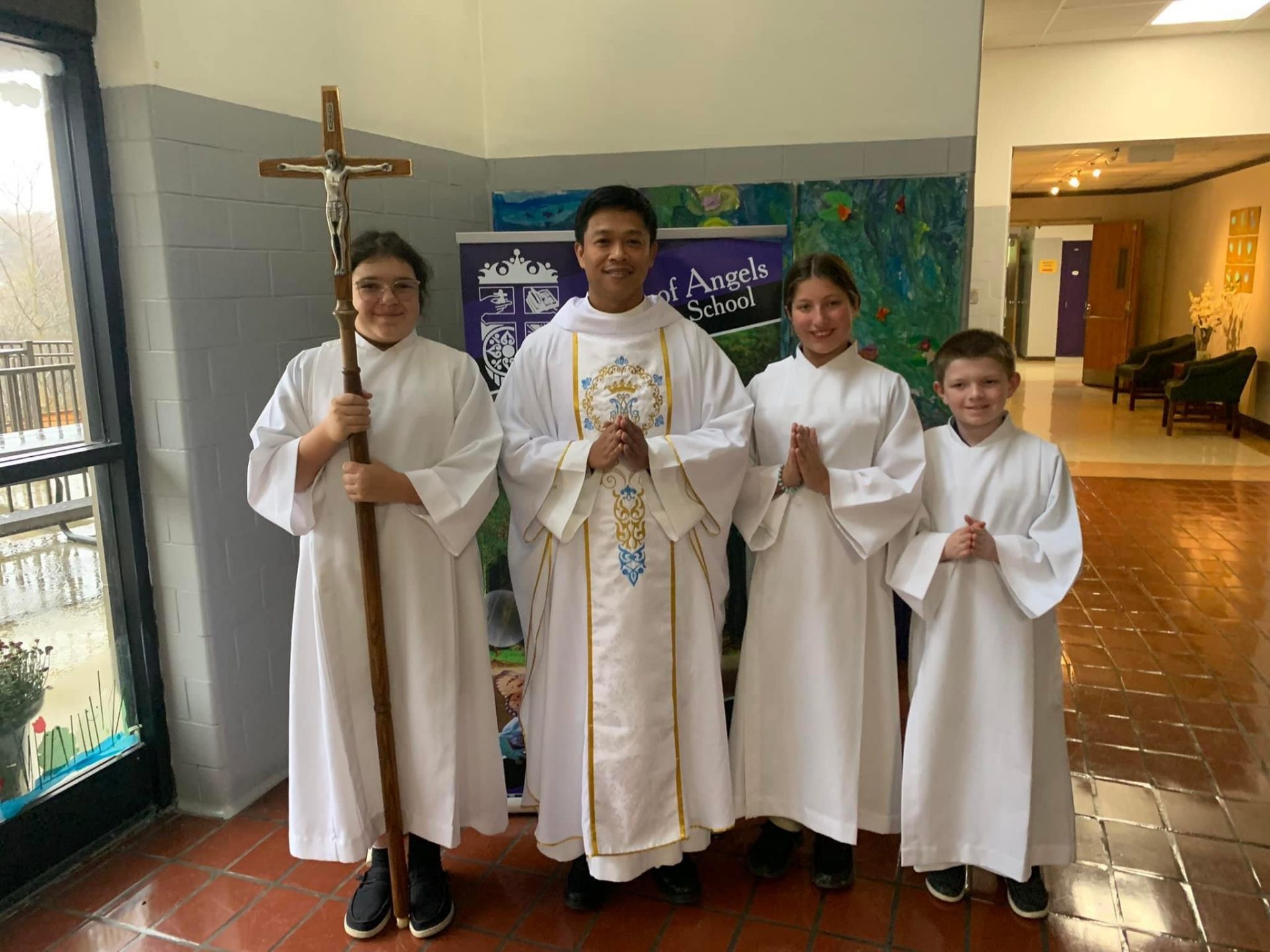
·         Participates through being a  cross bearer, server, cantor, lector, etc. at the celebration of the liturgy.

·         Reflects on the significance of Advent and Christmas traditions – making God’s love visible.

·         Will enter into the prayer, fasting, and almsgiving of Lent – a time of spiritual renewal.

·         Examines and understands the celebrations of Holy Week and the triduum.

·         Familiarizes themselves with the Easter theme – “being an Easter people.”

·         Researches and gives information on specific saints.

·         Explores how people of many nations honor Mary.

·         Uses art, music, and verbal expression to create appropriate Liturgical themes for school settings.

·         Is encouraged to participate in parish, school, and community activities focused on Liturgical themes.


Projects


·         Saints research and create mobiles/sometimes wreaths with information.

·         Dr. Seuss application to religion lessons and creative art projects.

·         Valentines for Veterans.

·         Maps and timelines depicting certain eras of faith.

·         Journey of faith crosses.

·         Create own prayer services.

·         Teacher and student created retreat.

·         Human sexuality class.

·         Service hours for graduation.

 
© Copyright 2009 | Queen of Angels Catholic School | A Pennsylvania Charitable Trust
One Main Street | North Huntingdon, PA 15642 | Phone: 724-978-0144 | Fax: 724-978-0171 | Feedback | Site Index

Grade 8